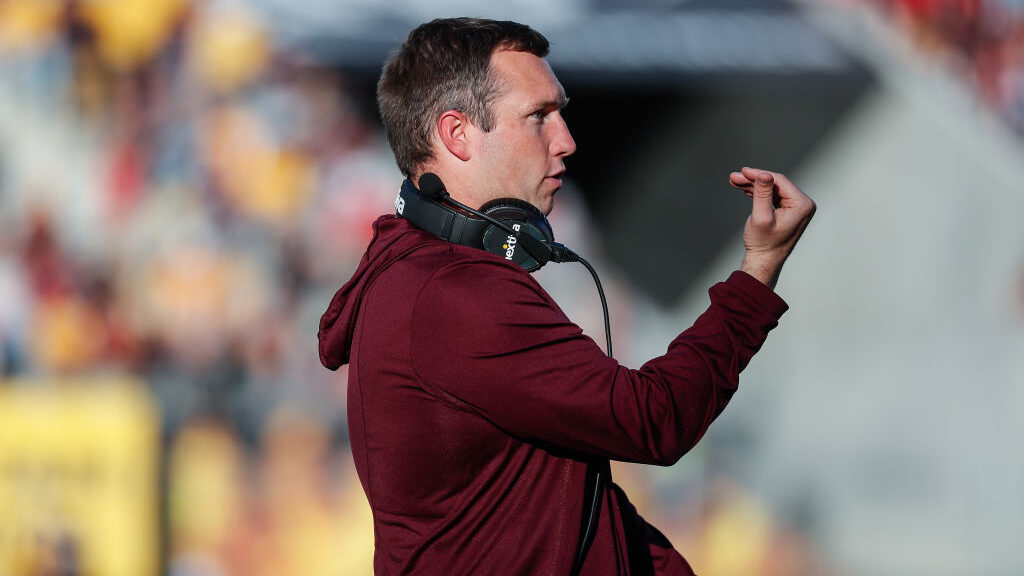
Is this the beginning of the end for Dennis Erickson at
Arizona State?
No, it's not. The groundwork was laid when the coach
followed up a 10-3 debut with seasons of five, four and
six wins.
That is not the way to get the job done, and if it weren't
for a bad economy there is a decent chance Erickson would
have been looking for a new job already. But, he still
wears maroon and gold, and for the first time since his
inaugural season is guiding a Sun Devils squad filled with
expectations.
While normally a good thing, being a preseason favorite to
win the Pac-12 South brings pressure not seen in a while,
a feeling that if the Sun Devils don't compete for the
Rose Bowl or, at least, make it back to the postseason the
head coach will surely be out of a job.
One of Erickson's former players, receiver Kerry Taylor,
thinks the 64-year-old coach's days in Tempe are numbered.
As a University of Arizona fan, few things make me happier
than to see a Sun Devils program in disarray. I'm
naturally still bitter about the
traveshamockery loss last December, and I
don't fully buy into the idea of 'Sun Devils: Pac-12 South
favorites.
However, Taylor's tweets were rather puzzling.
Taylor, from all accounts, never seemed to have an issue
with Erickson during his four years in Tempe. Choosing to
go to the school and play for Erickson, Taylor isn't a
player who had the misfortune of a coaching change during
his playing days. He signed to play for Erickson, and play
for Erickson he did.
Furthermore, it is not as if Taylor should feel like his
talents were wasted on the field. His last season was his
best, as he tallied a team-best 54 catches for a team-leading 699 yards and three touchdowns. Sure, bad
quarterback play didn't help things, but Taylor wasn't
exactly a top recruit whose chance at the NFL was ruined
by what happened to him in college. Quite the contrary, he
was a decent recruit who had a decent career. The reason
he was not selected in the NFL Draft has nothing to do
with how he was used at ASU, rather it was due to the fact
that he's a short receiver who is not exceptionally fast.
Maybe, though, Taylor is upset about how his career
finished up. Going from 10 wins in his freshman season to
15 over his final three campaigns, the losing and lack of
positive national exposure surely got to the player. That
seems to be the issue at hand; for some reason he does not
think Erickson will ever get things going in Tempe.
As a biased Wildcats fan I can't say I really disagree.
The only success Erickson has had was with Dirk Koetter's
players, and the last three seasons have been derailed by
the very things that tend to plague Dennis Erickson
squads: mistakes.
Whether it is penalties, dropped balls, turnovers or
missed assignments, Erickson's teams seem to self-destruct
on a semi-weekly basis. They've still won some games, of
course, because the roster is talented, but they've never
been so talented to where they can survive the
self-inflicted wounds. Erickson's Miami teams, where he
made a name for himself, were. The ASU Sun Devils,
unfortunately (depending on your perspective), are not.
That is not likely to change for Arizona State any time
soon.
And that is probably what caused Taylor to speak out.
A four-year player, Taylor would love for nothing more
than to see the entire country "Fear the Fork," and while
his method of speaking out is debatable, the fact that he
did speaks volumes of how he really feels. While many
would question him speaking out and saying these things,
you'd be hard pressed to find people who really, truly,
disagree with what he said.
While Taylor's remarks won't cause Erickson to lose his
job, they do add to the growing frustration with the
coach's inability to turn things around in Tempe. Should
the high expectations go unmet, again, chances are good
Taylor will get his wish.
The Phoenix Suns selected Kansas forward Markieff Morris with the 13th pick in the draft.
I tweeted about it, went and played some soccer and had dinner with friends. Then I went to sleep.
Upon waking up I came to a realization: I'm OK with the pick.
Though not a sexy pick, Morris certainly fills a need for a team that, honestly, had nothing when it came to the "power forward" position. At 6-9, 241 pounds Morris has the prototypical size and, based on his comments about Derrick Williams, confidence in his abilities.
He will fit in nicely, adding toughness, rebounding and defense to a team that lacks all three. Though not as flashy as the team's last forward (let's be honest, Hakim Warrick and Channing Frye aren't power forwards), there is nothing wrong with someone who can contribute double-digit points and rebounds while holding his own on the defensive end.
"We're a lot bigger, with one player, a lot stronger and a lot more dynamic just by adding one player to the lineup," Suns GM Lance Blanks said of the Morris pick.
All that may be true and, while playing it safe with this selection isn't necessarily a bad thing, it is not likely to accomplish what the team -- and many fans -- think it will.
If the goal is to have a player who can "keep the window open," the Suns are going to be pretty disappointed. Granted, that has less to do with what Morris can't do, rather he is just not the type of player who will transform the Suns from aging lottery team to a contender. He is, however, a solid piece to the puzzle, someone who is going to have a nice career in the NBA when all is said and done. The Suns didn't make a bad pick, because simply finding a contributor is a step up from many of their recent draft nights.
The problem lies in the fact that the Suns of June 24th still have the same big problem they had on June 22nd: a lack of a go-to scorer.
Now, I'm not saying one was available when the Suns picked 13th. Hell, I'm not even going to say they messed up a chance to get one. But if the Suns really plan on contending while Steve Nash is still under contract they will have to find one, because you can look up and down the roster as much as you'd like, but no matter how hard you try there won't be anyone on that list who can score more than 17 points a game. And, while having a bunch of players who can put in 12 or more is nice, the Suns found out last year the value of having a go-to scorer, someone to turn to in crunch time for the biggest buckets of the game.
That guy probably wasn't available at 13, unless you held a belief that Marcus Morris, Kawhi Leonard, Jordan Hamilton or any of the other players selected after Markieff could have filled that role. So, it's not as if the Suns really messed this one up.
"This gives us an opportunity to lay our imprint on this organization and this team," Blanks said. "Very excited to have the opportunity for the pick, but also a pick that reflects who we are and what we want to be about."
By the time the draft ended the Phoenix Suns were a better team than before it started. They are better on the glass, better on defense and a little younger. The roster now lists a legitimate power forward who is just 21, meaning he has some room to improve. However, if most "experts" are to be believed, the Suns' newest player is pretty close to his ceiling right now. That's not bad.
But it's also not great, and if the Suns want to contend again they'll need just that.
That the Arizona Cardinals need a quarterback is not news.
That the Arizona Cardinals are interested in Philadelphia's Kevin Kolb is not news.
That the Arizona Cardinals may trade Dominique Rodgers-Cromartie in exchange for Kevin Kolb? Now that's news.
It's also a bad idea.
Quarterback is easily the most important position on the football field. The Cardinals, of course, should do everything they can to not only improve from the train wreck that was the position last year, but position themselves for long-term success in the process. Is Kolb the guy, for now and the future? Who knows.
What we do know, however, is that the Cardinals have what could be one of the best defensive secondaries in the NFL, featuring DRC, rookie Patrick Peterson, Greg Toler, Kerry Rhodes and Adrian Wilson.
Think that won't be nice to have in a division that features Sam Bradford? How about the rest of the league? Then again, we don't yet know how good Patrick Peterson will be. There's a chance he's not as good a corner as anyone thinks or hopes. If that's the case the Cardinals will wish they had a guy like Rodgers-Cromartie around.
Don't let last season fool you, the NFL is still as pass-happy as it ever was. That the Cardinals couldn't stop the pass was just as much of a problem as their inability to complete one, and in no world does trading their most proven corner benefit the team's defense.
Granted, it is not as if DRC had a banner year. By pretty much everyone's standards he had a rough 2010, and all it took was one look at him to see things were not right. A Pro Bowler in 2009, up until last season - when everything went wrong for the Cards - the 25-year-old was considered to be one of the team's best up-and-coming players, someone who could lock down one side of the field for years to come.
Does one down season negate the good ones that preceded it? Does a rough season mean the guy is not as talented as previously thought? Or, perhaps, his immaturity (shocker for someone so young, I know) led to him struggling with the mental aspect of the game while his team was barely competitive most games. Was his play an issue last season? Absolutely, but he wasn't the reason the defense struggled, at least, not the only one.
The fact is DRC is a playmaker, something every defense needs. Is he Champ Bailey or Charles Woodson? No, he's not that physical. But from all accounts he has been working hard to bulk up, hoping to become a better tackler. Just getting bigger won't make Rodgers-Cromartie a better tackler, sure, but he seems to be putting in the work to improve, and that can only be taken as a good sign.
But people seem ready to throw what could be a bright future away for an unproven QB.
The Cardinals most certainly need an upgrade at the position, but must avoid getting desperate to the point where any QB not named Anderson looks like the of second coming of Tom Brady. Let's not forget that defense wins championships...
Is Kolb an upgrade over Derek Anderson? Sure, but most of the league's QBs are. Is he a guy that can lead the team back to the playoffs and, hopefully, the Super Bowl? That is the million dollar question, but one that is not worth betting a young, Pro Bowl cornerback on.
Though it may be difficult to believe sometimes, I am a Phoenix Suns fan. I grew up watching the team and would like nothing more than to see someone wearing purple and orange hoist the Larry O'Brien Trophy.
It is for those reasons why I have been frustrated with the moves they've made over the last seven few years. Watching a team that was so close to a title fall short, largely because of self-inflicted wounds, has not been easy to take.
Back in the lottery, the Suns are rumored to be interested in trading up to the No. 2 spot, securing Derrick Williams while parting with Marcin Gortat.
At first glance I agreed with my colleague Espo, who says the team can't afford to trade Gortat. The move would have the appearance of a classic 'Bad Suns' move, a foolish trade that would set the team back. Thinking about it a little more, though, I decided the trade wouldn't be such a bad idea after all. In fact, I'm all for it.
The saying when someone refuses to acknowledge the truth, at least the one I've heard, is that denial's not just a river in Egypt.
They're right.
As it turns out, the denial river goes straight through the U.S. Airways Center, where the Phoenix Suns do business.
In a recent column by the Arizona Republic's Scott Bordow, Suns VP of Basketball Operations Lon Babby was said to have talked about the risk in completely tearing down a roster and going through a rebuilding process.
Babby and other team officials have examined the history of teams that, like the Suns, stalled at the conference-finals level and then had to decide whether to keep their core players together or tear up the roster. What they discovered: Teams that embarked on a massive rebuilding project took an average of 10 years to get back to the conference finals.
Saying you end up being at the mercy of ping pong balls, Babby basically explained why the Suns have no interest in blowing up a Western Conference Finals team for the slim hope of being able to take the next step with a different group of players. However, there's a problem.
The team you see today is not a Western Conference Finals team that just can't get over the hump, as Babby seems to insinuate. No, it's a lottery team that barely resembles the one that took the eventual champion Lakers to six games, with only five players from that team still wearing purple and orange.
In all honesty, whether or not Babby and the Suns want to believe it, the rebuilding process has already begun. So why does the team continue to lie to itself and the fans?
If is out of fear, the team is only delaying the inevitable. At some point Steve Nash and Grant Hill will not be around - that much is a given - and odds are that time is coming sooner rather than later. For some reason I have this picture of Babby, Lance Blanks and Robert Sarver , whenever someone brings up life without their veteran leaders, going "lalalala I can't hear you" while plugging their ears with their fingers. Real mature, I know, but listening to them so much as discuss the idea of moving on seems like an exercise in futility. Now that a team they used to battle with won a championship, the chances of the Suns truly tearing things down probably got even slimmer.
Having watched a Dallas Mavericks team that essentially stayed the course hoist the Larry O'Brien trophy Sunday night it would be easy to see what Babby and the Suns are thinking. You don't have to blow it up to get better because making small tweaks to the roster can get the job done. The Dallas team that lost to Miami in 2006 went through changes, but the core of Dirk Nowitzki, Jason Terry and…oh, that's it.
The following seasons were spent with playoff choke jobs and disappointment, but that time was not wasted, as the team made numerous changes, choosing to keep Dirk and JET as the core while looking for the right pieces to surround them with. It made sense, as 27-year-old Nowitzki and 28-year-old Terry were still in their primes when they lost that first NBA Finals, and were players who for sure had a half dozen good years left in them. That offered the necessary time to make small changes, time the Suns just don't have with their supposed ‘core.'
The final problem with comparing the Mavs to the Suns is that Dallas boasts arguably the two most important things to winning a title, neither of which the Suns have: a superstar and an owner with an intense desire to win. Until the latter is fixed the chance to acquire the former will be delayed at best, lost at worst.
As the Diamondbacks embark on a road trip it gives us a chance to take stock in what we have.
The team is contending for the NL West crown, there are a few legitimate All-Star candidates, they have a solid foundation of youth and, unfortunately, some struggling fans.
Averaging 22,910 a game through 33 home dates, Chase Field has been about 47 percent full. My problem, though, is not with the amount of fans at the games. The economy means people have to spend their money wisely, and while the D-backs are one of the cheapest tickets in town, the decision to spend money elsewhere is completely understandable.
No, my issue is with fans who show up and, quite frankly, seem lost the second they walk through the doors. Fear not, as my plan isn't to complain; I want to help. With a full week before the teams' next game in the Valley of the Sun, there is time to implement a few changes.
Do, whenever possible, show up a couple hours before the game and take in batting practice. Some of my fondest memories as a kid was getting to games early and trying to track down home runs hit during batting practice (I even caught one Matt Williams hit in 1999). Sure, you'll end up with some time to kill once the players are done, but that can be filled by various activities, such as eating, walking around the ballpark or just relaxing.
Don't show up in the fourth inning like the fans who asked my buddy and I to move Saturday evening because ‘we were in their seats.' Yes, we were, but that's not the point. By that point in the game if you are not in your seat it pretty much becomes fair game. Besides, the section was pretty much empty at first pitch so we grabbed the first seats we saw in the row, making sure everyone else in the section had ample room to stretch out and be comfortable while watching the game. Our bad.
Sitting atop the NL West for the first time in a long time, the Diamondbacks are looking every bit the contender, something few of us really thought possible as recently as one month ago.
So excited, is everyone, that the team's management is looking for this team to be buyers, rather than sellers, as the trade deadline approaches.
And why shouldn't they be? The NL West is there for the taking, and the right move could propel the team even further than just a division title. Seems great, right?
Well, let's allow the 2008 Diamondbacks to serve as a cautionary tale for the 2011 version.
That team, fresh off a run to the 2007 NLCS, fancied itself a contender. A 20-8 start following an offseason trade for Dan Haren gave this team the look of a champion. Then the rest of the season happened.
Struggling to keep pace with the surging Los Angeles Dodgers, the D-backs pulled off a couple of trades, landing Adam Dunn and Jon Rauch in separate deals.
For Dunn's 44 games, eight home runs and 26 RBI the D-backs surrendered Micah Owings and prospect Wilkin Castillo, while Rauch cost Arizona Emilio Bonifacio in exchange for an 0-6 record and 6.56 ERA in his first 26 appearances as a Diamondback.
The trades did not help Arizona - in fact, one could argue they hurt the team - and Arizona faded from playoff contention, finishing the season 82-80 and looking up at the Dodgers in the standings, proving it's not about just making a deal, but making the right one.
The wrong one, we've seen, not only affects the current season, but future campaigns as well. That's what Kevin Towers and the Diamondbacks need to keep in mind. I'm confident he'll make the right decision.
Kevin Kolb appears to be the favorite, not only to become
the Cardinals next starting quarterback but also in the
minds of Cards fans in general. With so many options out
there - some of which have Pro Bowls and 20+ TD seasons on
their resumes, I can't help but wonder why that is.
Trust me, I get it. Kolb is better than anything the
Cardinals had last year. Still, is that enough of a reason
to pay a king's ransom for a player, because he's better
than the Derek Anderson/Max Hall/John Skelton triumvirate?
Hell, I'm a better soccer player than my mother (sorry
Mom), but that doesn't mean my team should be happy to
have me on board.
But I digress.
Unfortunately, the very fact that Kolb is not Derek
Anderson seems to be enough for many people, including
ESPN's John Clayton. However, even as one of the strongest
advocates of Kolb to Arizona, Clayton, basically said that while Kolb
may not be great, he's worth the risk because he's not
terrible.
Clayton's terrible reasoning notwithstanding, how can
anyone say, with certainty, that Kolb is, in fact, not
terrible? While a career rating of 73.2 isn't terrible,
it's less than five full percentage points above
Anderson's, and there's not much about 11 career touchdown
passes against 14 interceptions that screams greatness.
Incidentally, this
guy thinks Kolb's statistics are more A.J. Feely than
Aaron Rodgers.
The Arizona Diamondbacks are partying like it's 2007.
Remember that season? The D-backs, in Sedona Red for the
first time, won 92 games and the National League West
crown with smoke and mirrors - and a little pitching.
That team, if you recall, was outscored by 20 runs over
the course of the season and was led by the fake
as hell always hustling Eric Byrnes on offense
and CY Young candidate Brandon Webb on the mound.
While they were the big names (and Orlando Hudson the All-Star), it was a bullpen that won games, as well as saved them, that led the team to heights not seen since.
Juan Cruz, Tony Pena, Brandon Lyon, Doug Slaten, Jose
Valverde. Once the game was put in their hands the game
was over, meaning all Webb, Doug Davis, Livan Hernandez,
Micah Owings or whatever starter toed the rubber that day
had to do was pitch about six strong innings. Do that,
leave the game, watch the ‘pen go to work and lock it
down. A team that can shorten a game, so to speak, is one
that can hide a lot of deficiencies, which is exactly what
happened four years ago.
They're doing it again.
I think back to something pitcher Joe Saunders said after
the Diamondbacks rallied for a win over the Braves last
week, when I asked him about the team's starting pitching
being a motivating factor for the rest of the team to play
well. After all, a starter keeping the team in the game
gives the bats more time to wake up and score some runs.
"Baseball's a funny thing," he said. "It seems like what
makes the good teams good teams is that when the hitting
isn't really clicking on all cylinders the pitching picks
it up and when the pitching isn't clicking on all
cylinders the hitters pick it up."
That confidence was missing the last few seasons -- with
good reason -- but for now seems to have returned to Chase
Field, and its importance cannot be overstated.
Because of Nash's brilliance Suns fans, or at least a good majority of them, believe the way he plays point guard is the right way to play the position.
Indeed, Nash has been great since returning to the Valley; two MVP awards, three trips to the Conference Finals and piles of points would attest to that. Averages of 11.5, 10.5, 11.6, 11.1, 9.7, 11 and 11.4 assists per game are evidence that Nash would look to pass before taking a shot himself, and if you're still unsure then take a look at Shawn Marion, Amare Stoudemire and Marcin Gortat for further proof.
However, Nash's unique ability, while great for the Suns
the last seven seasons, has also led many to believe the
way he plays point guard is not only the right way, but
the only way as well.
Case in point a question I posed on Twitter late last
week, asking if the Oklahoma City Thunder would be a
better team if Nash was their point guard instead of
Russell Westbrook.
Both of these responses are from Suns fans who know the
game and are passionate about the team, but they are also
emblematic of the inherent flaw in how Suns fans view the
point guard position. It seems, after all, that a point
guard who scores is not viewed as one who could also win.
The theory that a guy like Nash would make the rest of
the players on the Thunder better may be true, but
would the team itself improve? Oklahoma City did win 55 games this past season, so it's not like they underachieved under Westbrook's stewardship.
As it stands, ZoDogg34 and yrite4 have company in the "no pass, no win" club, a group that feels OKC would be better off with a point guard like Nash, who tallied 14.7 points and 11.4 assists per game over Westbrook, who finished the regular season with averages of 21.9 and 8.2.
While Nash has a better assist to turnover ratio and
Westbrook is a superior defender, the idea that a score-
first point can't win is as ludicrous as it is narrow
minded. In fact, as many teams function without a point
guard initiating the offense, it can be argued that a
squad is better off with their primary ball-handler being
someone who can put the ball in the basket. Case in point: this year's conference finals teams.
As the NBA's old guard dynasties have come crashing down they have brought the realization that all good things must come to an end. The Spurs, Lakers and Celtics all bowed out of this year's postseason, sometimes in a less-than-graceful manner (I'm looking at you, Los Angeles), and with them went the dynasties of the last decade. And that's OK.
Of all leagues the NBA tends to be the most cyclical, and that's because the best teams are built around superstars. From the time a team acquires one their job is to surround him with the right mix of talent, hope to win some titles and then move on when the player just doesn't have it anymore. As difficult as it may be to break up championship teams and part with once-great players, the tough decisions are made because they're in the best interests of the team.
And, no matter what direction the Spurs, Lakers and Celtics take from here, they can do so knowing they gave their superstars the pieces they needed to win a title.
The Suns can't make that claim, though they certainly fall into the same group of teams that have exhausted their chances.
Now it's true that Steve Nash is not on the same level as Tim Duncan or Kobe Bryant, and while he's comparable to Paul Pierce he never played with anyone as great as Kevin Garnett or Ray Allen (in their primes). Still, the pieces were there to make something happen and the Suns seemed content with doing the bare minimum in trying to do so.
In 2004-05 Phoenix had one of the youngest teams in the league and featured Nash along with Amare Stoudemire, Shawn Marion, Quentin Richardson and Joe Johnson. Rather than keep this group together and build the Suns chose instead to make some drastic changes.
When Gary Williams abruptly retired as head coach of Maryland basketball, there was not a thought in my mind that the decision would have a ripple effect that would reach Tucson, Arizona.
That was Thursday, and although Sean Miller's name had been linked to the job, I laughed off the possibility, instead saying how happy I was that other schools wanted to hire away our coach. After all, nobody would want him if he wasn't doing a good job -- which he is -- so it's only natural that other schools would be interested. Of course, there was no way he would leave Tucson, not after a Pac-10 title, appearance in the Elite 8 and top 10 recruiting class on its way.
Then Friday arrived, and with it came a bunch of speculation and rumors, ranging everywhere from Miller's wife not liking Tucson because of allergy problems to Maryland being Sean's "dream job." Ruh roh.
Following reports Saturday that it was all but a formality, I mentally began to prepare myself for one of the biggest let-downs in UA basketball history, one that would rival Illinois in 2005 and UConn not long ago. Then came this tweet:
But really, this weekend signaled a lot of things for Arizona and its fans, and where you fall along the isle will determine what exactly you take from the experience.
On the upside, Miller has come out and said the flirtation with Maryland only helped re-affirm what he already felt, which was that Arizona was the perfect opportunity for him.
"Nobody is happier to be head coach at any place in the country than I am here at the University of Arizona," he said. "If the deeper meaning of this weekend is that I'm here for the long haul, unconditionally, that's what that means. I am."
Recruits may feel that if he turned down a good chance to head back East now he won't ever leave, and being the most talked about coach in the nation probably doesn't hurt his street cred when trying to land the nation's top recruits.
On the downside, maybe this shows that while Miller really does have interest in going back east, Maryland proved to be a bad fit.
Roughly nine months ago I wrote that I did and everyone else should too. I felt he had a good grasp on the team's QB situation in the post-Warner era and the team, while likely taking a small step back, would not be in too bad of shape.
Well, as they often say when Mark Reynolds is at the plate, swing and a miss.
But now he gets another chance, assuming the league and players come to some sort of labor agreement, to find someone - anyone - who can lead an offense good enough to get the Cardinals back to the playoffs.
Sure, there are plenty of options out there, though there are no sure things on the market. Maybe that's because teams don't let a QB leave unless there is something wrong or serious doubts.
And therein lies the rub for the Arizona Cardinals.
I'll admit it, I'm not a fan of Kevin Kolb. The current frontrunner in the QB race, I have been less-than-impressed with what has been a mediocre career up to this point. He has room to improve, of course, since he's only 26 and has played in all of 20 NFL games, but I'm really nervous about the Cardinals giving up a high draft pick and maybe even a player to acquire the Eagles backup.
To me, acquiring Kolb at the price he's likely to command means a few things, most importantly that they think he's a franchise quarterback. You don't give up high draft picks for players you hope will be good, but you do move them for ones you know will get the job done. Whiz and the Cardinals would not be trading for Kolb so he can compete for the starting job, they would be making the move so they could give the job to him.
Mel Kiper Jr. gave the Cardinals an A. ESPN's John Clayton and Sports Illustrated's Don Banks both list the Cardinals as one of the draft's winners.
Oh, that 2006 draft really set the table for the dominant Cardinals team you see today.
As draft grades continue to pour in from various different sources it is important we remember one easily forgettable fact: No one knows how any of these players will turn out.
Kiper's grade, in 2006, was based largely on the Cardinals' first round pick.
"The Cardinals' QB of the future, Matt Leinart, fell into their lap at No. 10 (I had Leinart as the third best player in the draft). Guard Taitusi "Deuce" Lutui (second round) and TE Leonard Pope (third round) were great picks."
One out of three would make a Hall of Fame hitter in baseball, but it does not help in building a football team.
Clayton mused about the Cardinals, normally a bad luck team, finally receiving some good fortune, starting with the signing of Edgerrin James.
"Twice this offseason they struck gold. They headed into free agency without the intention of paying big money for a running back. But with a surprising $17.5 million increase in the salary cap, the Cardinals were able to sign Edgerrin James. Then, Matt Leinart was gift-wrapped for them at No. 10."
Rumors started to circulate about the team trading down, which were bad enough, but then they were followed by talk of them reaching for Missouri defensive end/linebacker Aldon Smith.
Oh boy.
The last time the Cardinals traded down was 2003, when they passed on Terrell Suggs (and the guy I wanted, Byron Leftwich) and traded from sixth to 17th and 18th. Supposedly the guy they were targeting ended up being picked before their turn came around, and they were left with Calvin Pace, Bryant Johnson and bewildered fans.
Furthermore, the last time they passed on a Peterson in the top 10 in order to draft for a position of need they ended up with Levi Brown who, while not the worst player ever, is not worthy of his draft spot. Then again most people, except for the Cardinals, had that opinion of the player on draft day.
Ultimately, however, the Cardinals stood pat and, while maybe not filling a position of need, added the guy many believe is the best player in the draft. If that's not the definition of winning, well, I don't know what is.
I have not failed. I've just found 10,000 ways that won't work. ~Thomas Edison
The hesitation with drafting quarterbacks is understandable. The last time Arizona took a QB in the first round the Cardinals selected Matt Leinart, and all they were ultimately left with was four years of failure with a side of crushed hopes and dreams. Before that? Tony Sacca, in 1992, and he followed the great Kelly Stouffer, who was chosen in 1987. Look at this history and it is apparent the Cardinals are to drafting quarterbacks what Derek Anderson is to completing passes.
Still, everyone and their mother knows the Arizona Cardinals need a new quarterback.
Nobody wants to sit through another season similar to the one led by the quartet of Derek Anderson, Max Hall, John Skelton and Richard Bartel, but the only way to guarantee an avoidance of a repeat would be to draft a quarterback at some point over the weekend.
Yet, many people, including Tyler Bassett, are hoping the Cardinals don't go anywhere near one of the top QBs in this year's draft.
I'm really not sure why that is.
If the Cardinals need a quarterback and the only way to get one is through the draft, why not go ahead and fill that need? It's kind of an important position to fill and besides, are rookies really so bad?
The NFL Draft is only a couple days away and who the Cardinals will take is a
mystery. The Cardinals have plenty of holes to fill -- the most glaring being at QB -- and there
are a number of useful players who should be available at number five when the
Cardinals are finally on the clock. Who do you want them to take? Check out this chart, it should help you out a little bit. Just follow the lines to make each decision, and at the end you'll have your choice.
Let's go Coyotes…Let's go Coyotes…Let's go Coyotes…
The chant echoed around Jobing.com Arena Wednesday night,
not long after the game ended but long after the game, and
really the series, was no longer in doubt. Only now, with
the Coyotes season over, one could follow that chant with
a simple question.
Where?
Throughout this entire season, and especially over the
last few weeks, rumors have been swirling around the
Coyotes. Would they be sold to Matthew Hulsizer? Did the
deal fall through? Will the team call Canada its home by
next season? If they weren't already, all those questions
will now come to the forefront after the team was swept
out of the playoffs and into the off-season by the Detroit
Red Wings.
"It caps off just a, I don't even know what the word would
be, a miserable year off-ice for this organization,"
defenseman Adrian Aucoin said. "I think the players did
just about everything we could, and we did unbelievable
under the circumstances.
"Come playoffs they're still driving it through our brains
that we might be moving out of here so it was tough."
Heading into the 2011 Stanley Cup Playoffs everyone, to a
man, knew the
Phoenix Coyotes would go only as far as goaltender Ilya
Bryzgalov could
take them.
At this rate, that will be to Game 4 of the first
round.
The Coyotes fell to the Red Wings Monday in what anyone
could have
labeled a "must-win" game.
Before the sold
out crowd at Jobing.com Arena could get to their seats
Detroit was up 2-
0.
"It takes the crowd out of it and it was a pretty quiet
first period because of
those two goals," forward Kyle Turris said after the loss.
"It's tough when
they score
early."
No kidding.
Clearly, Detroit is the better team. They have more stars,
more depth, more
talent and more fans. But Bryzgalov, a Vezina Trophy
candidate, was
supposed to be the great equalizer, the one who could
negate all other
deficiencies and make this a series. Problem is that's
just not happening.
Bryzgalov has been torched for 12 goals in three games
and, since taking a
1-0 lead early in game, the Coyotes have not led for more
than 167
minutes of hockey. While all of the blame doesn't fall
squarely on #30's
shoulders, as the team's best player and last line of
defense, he needs to be
better. He must be better.
However, that does not mean he's in danger of heading to
the bench. Head
coach Dave Tippett, lamenting two "really nothing shots"
that went in, said
there has been no consideration to pulling Bryzgalov for
backup Jason
LaBarbera.
"Bryz got us to this point, we're going to rely on him to
get us out of this,"
he said. Tippett noted, though, that his netminder has
played "just alright"
through three games.
Saying goodbye is never easy. The idea of being without
something we've grown accustomed to leads to a flood of
different emotions, whether it be anger, sadness,
indifference or something else.
Still, there comes a time when we must recognize what once
was, acknowledge an existence, and consider the impact one
had on our lives. With that, it is time to remember the
2010-11 Phoenix Suns.
The team began the year, right or wrong, with some lofty
expectations. Having suffered through some major setbacks
before they even had a chance, many thought they could
persevere and be more than they were set up to be. They
did not fail to meet the expectations I had placed on
them, though I'm aware some people were left wanting just
a little more. I wouldn't blame the 2010-11 Suns for that,
as they weren't the ones who placed unreasonable
expectations on themselves.
Seemingly behind the 8-ball from the start, the team did
the best they could (most of the time) and left us with
some moments we can look back upon with fondness.
Take, for instance, a cool night in November where the
team made 22 three-pointers and beat the defending
champion Lakers in their house. That was fun in large part
because it was so unexpected, and it was a night we talked
about for days after.
Furthermore, remember that win against the big, bad
Celtics? Where the team showed toughness and grit,
something we thought they lacked all along? At the time we
hoped it would be the beginning of something special but
alas, it was just not meant to be. Even so, I don't think
any of us would give that win back, and nor should we.
After all, there weren't many of them this season.
Still, the seven months or so were not a complete waste of
time, even if it may seem that way now. There is what the
time did for Grant Hill, allowing him to showcase
defensive ability few knew he had. Of course, who could
forget about Channing Frye, who discovered that there was
more to him than we originally thought. He proved his
worth all throughout the year, emerging as one of the
team's better players. Jared Dudley emerged as well, going
from solid role-player to valuable starter by season's
end.
The Phoenix Suns are on the verge of making a huge
mistake.
A 7 foot, 255 pound mistake, to be exact.
The Suns, it would seem, are ready to part ways with
center Robin Lopez, which wouldn't seem like such a bad
thing given the year the Stanford alum has had.
Averaging just 6.7 points and 3.3 rebounds per game, Lopez
is having what has to be classified as a miserable season.
Poor on the glass, weak taking the ball to the hole and
generally awful, Lopez lost his starting job to Marcin
Gortat and has seen his per-game minutes average fall from
a high of 25 to begin the season to a low of nine in its
final month.
Then, to top it off, Lopez was the third center off the
bench against Minnesota, registering a hearty zero points,
one rebound and three fouls in a little more than six
minutes of play. While giving up on the 23-year-old may
not seem like a big deal, especially when he's putting up
lines like that, cutting ties with the man affectionately
known as "Fropez" (OK, I may be the only one who calls him
that) would just be another sign of the Suns'
unwillingness to show the requisite patience to develop
young players.
Think about it: Who was the last player to be selected by
(or for) the Suns who then developed into a quality player
while still wearing purple and orange? Give up? Leandro
Barbosa.
That's right, the Brazilian Blur was the last player the
Suns took from rookie to solid rotation player, and he was
drafted in 2003. And you wonder why the Suns are one of
the oldest teams in the league…
The Suns have a history of, when they're not selling picks
on draft night, giving up on them before they see the end
of their rookie contract. Going as far back as Zarko
Cabarkapa, the Suns have given their rookies little rope
before declaring that they will be of no use and moving
on. While you will not find a player in that group who has
gone on to flourish with another team (though the jury is
still out on Clark and Dragic), the point is the Suns
either can't properly identify talent in the draft or are
too impatient with their "win now" mentality. Well, the
Suns are a lottery team, so that really shouldn't be a
problem at this point.
Even still, Lopez, unlike most Suns busts, has actually
shown glimpses of not only competence, but good play. As
recently as one year ago the Suns and fans were pining for
the big man's return to the court, as his insertion into
the starting lineup provided the spark the team needed to
capture one of the West's best records, and his return in
the Western Conference Finals gave the team some much-
needed size to battle with the Lakers up front.
How soon we all forget…
Lopez, for all his faults, is still a legitimate center.
Usually the biggest player on the floor, his size is a
great deterrent for opposing players around the hoop. He
showed impressive ability to finish around the hoop last
season, and his quickness looked like a great asset,
especially for a player his size. He has a competitive
fire that has led him to shattering doors as well as
getting into it with opposing players, flashing a mean
streak that makes you believe he not only cares but will
work hard to improve his game. But, as happens with quite
a few centers, Lopez's career has been wrought by injury.
Whether it's injuries to his knee, back, whatever, one
thing that's certain is the next season Lopez makes it
through healthy will be his first. That has to be a
concern, without question, but it also has to be cited as
a reason for his struggles this season.
While Suns President of Basketball Operations Lon Babby has come
out and said his center is not injured, I'd be willing to
bet Lopez is not 100 percent healthy either. The explosion
that made Lopez such a promising prospect just one year
ago has been absent this year, and the reason can be
traced to the back injury he suffered last season, which
left him with nerve damage in his right leg. That type of
injury takes time to heal, though it is something Lopez
has said he must learn to
play with and play through.
The good news for the Suns is that, while Lopez is
searching for his explosiveness, the team is not at the
same time looking for a center. Marcin Gortat has been a
real revelation for the franchise, consistently posting
double-doubles and providing the team with the inside
presence it desperately needed Lopez to be. Most NBA
centers wouldn't look so impressive when compared to
Gortat, so naturally a struggling Lopez looks downright
awful.
When the season began Robin Lopez, for all intents and
purposes, was the team's only big man. The team needed him
to step up and, for whatever reason, he did not. With
Gortat now on board the Suns can actually afford to really
work with the former first-round pick, allowing him the
necessary time to get fully healthy and regain his
explosiveness. When he does, watch him again show the
skills that had everyone excited about him no more than 10
months ago. Just think of how painful it would be to see
him do so in a different team's uniform.
I'm often told that, when it comes to my views on sports,
I'm a negative person. People say I refuse to see the
glimmers of hope, that I see most situations in a "glass
half empty" kind of way.
From my saying the Suns had a bad offseason and would be
mediocre at best in November to calling out Steve Nash for
poor play after the All-Star break, along with saying the
luster has worn off Ken Whisenhunt, the point was I just
couldn't be happy with these teams. Whether I was right or
not didn't matter, they just wanted me to be more positive
about the local teams.
Well, I'll tell you what: I'm positive when it comes to
the Arizona Diamondbacks. I have no doubt they'll stink
this year, and I'm perfectly fine with it.
Thing is, I know teams will have their ups and downs. I am
perfectly capable of understanding that a team won't
always win and, as a fan in the Valley of the Sun, it's
almost wrong of me to expect my teams to win. I get that.
All I ask for, honestly, is progression, that the teams,
if they are not competing for a championship, are making
an effort to get to that level.
The Suns, trailing by three with just over a minute to go in an, for all intents and purposes, must win game against Dallas, came out of a timeout needing a bucket.
Getting a desperation three from Channing Frye was bad enough. That he fired away through a defender, attempting to draw a foul, was hardly smart. Doing all that with 17 seconds left on the shot clock? Unacceptable.
So, at that point the plan was to look deeper into the Suns' late-game execution, or lack thereof, and wonder aloud (or on paper) whether or not head coach Alvin Gentry was to blame. He is, after all, the one drawing up the plays, so when they go horribly, horribly wrong one can surmise that it's partly his fault.
But then I got to thinking, wondering if this is really the best this roster is capable of, that the roster is so poorly constructed that Gentry never really had a chance.
Of course, he would never say that. Questioning the people who sign your paychecks is rarely a good way to survive in any industry, let alone professional sports, and nothing about Alvin Gentry screams "idiot."
In fact, having been to many a press conference where Gentry was forced to explain a tough loss, I'm going to go out on a limb and say that if the coach could be honest with us - I mean really, brutally honest - he'd tell us about how he saw this coming but could do nothing about it.
The market for elite signal callers is mediocre, though there are a few decent options to choose from.
One of the possibilities is a 26-year-old who averaged 6.5 yards per passing attempt and has thrown touchdowns on 3.4 percent of his passes while being picked off on 4.4 percent of his attempts. Thought to finally be getting his opportunity to lead his team, he suffered an early-season injury and opened the door for a veteran to come in and take his place. When he did get back on the field he was average - not great - and the team ultimately decided the veteran gave them the best chance to win. A once-promising career has been put on hold as the quarterback - who believes he can be an effective starter in the NFL - is hoping to find a team that will give him an opportunity.
Another option is a 27-year-old who has experience in a system similar to Arizona's, has averaged 6.5 yards per attempt and has thrown a touchdown on 2.4 percent of his passes while being interecepted 3.4 percent of the time. Originally anointed the starter by his team, he got hurt early in a season where he wasn't playing great to begin with and was subsequently replaced by a veteran who, somewhat surprisingly, went on to have a Pro-Bowl campaign. The veteran re-established himself as a top-flight QB in the league, seizing the starting job and relegating the youngster to the bench.
Factor in the career QB ratings, with the former sitting at 73.2 with the latter at 70.8 and you may have a tough time deciding who gives you the best chance to win going forward: Kevin Kolb or Matt Leinart.
That's right, the quarterback so many seem to want the Cardinals to give up the farm for is not that much different than the one they ran out of town not eight months ago. Irony can be a funny thing, no?
Don't get me wrong, I'm not saying the Cardinals should bring back a quarterback who apparently couldn't beat out Derek Anderson, feuded with his head coach and was a third stringer in Houston for the duration of last season. Leinart's tenure as a Cardinal was as disappointing as it was brief, and that ship has surely sailed. The point is while Kolb is being hyped as the next great QB, he's really as much of an unknown as any other player would be with just seven career starts and 319 total attempts.
Could Kolb be a good quarterback? Sure, why not. He's 6'3 and 218 lbs., meaning he has good size. His arm strength is solid and he's been coached by one of the best in Andy Reid the last four years. However, the Houston product is no sure-thing, and if the Cardinals are to give up draft picks (especially their first rounder in 2011) merely hoping they are getting the franchise's long-term answer at the most important position is not enough - they must know.
The Cardinals need a quarterback in the worst way, and while Kolb may be the most enticing option the idea that he is the best one has the scent of ‘after what we saw at the QB spot last year simply average would be awesome.' Yes, average would be an upgrade, but average doesn't win Super Bowls. Great does, and if you are sacrificing picks along with the big contract that would be handed to Kolb upon trading for him, you need to get great.
So, is greatness available? Well, in free agency, probably not. Teams know better than to let a franchise QB hit the open market, and players like Kurt Warner and Michael Vick only do so if they are carrying some level of baggage, be it on the field struggles or off the field issues. So, while a guy like Marc Bulger may be the choice, it must be understood that expecting him to have a career renaissance like the one Kurt Warner went through is a little unfair, as lightning doesn't strike twice in the same place very often.
Of course, the Cardinals could turn to the draft, but as they found out after taking Leinart 10th overall in 2006 there is the classic boom/bust potential and inherent risk that comes with taking a QB in the first round. Granted, Auburn's Cam Newton, Missouri's Blaine Gabbert, Arkansas' Ryan Mallett and others have the potential to be stars, but the Cardinals are really in no place to take that chance - unless of course they have a solid veteran to take the snaps while the franchise's future learns and matures on the sideline.
Which leads us to the final option: trade. Carson Palmer wants out of Cincinnati, the Broncos' Kyle Orton may or may not be available and of course, there's the aforementioned Kolb. Going this route means the Cardinals would have to give something up, meaning the cost absolutely plays a factor in whether or not the team should pursue. While we don't know the asking price for each (or if Palmer and/or Orton are even available), the consensus seems to be that Kolb will be the most expensive.
And that price, ultimately, may be too much to pay when you realize you're not even sure of what you're getting.
Members of the Arizona Wildcats had a saying they liked to use on Twitter this season, especially after wins.
#weneverleft
While fun, the phrase is technically incorrect. The Wildcats did leave, so to speak, and their time away changed a fan base that was used to expectations, deep tournament runs and NBA-level talent wearing the red, white and blue.
Never has this been more evident than Sunday afternoon when, not long after the clock reached 0:00 with the Wildcats ahead of the Longhorns 70-69 and heading for the Sweet 16, concerns were brought to my attention.
No, I'm not talking about the five seconds call, iffy fouls or whether or not Arizona actually has a chance to beat Duke. Those would be legitimate and are definitely worth talking about.
Surprisingly - and maybe even disappointingly -- the conversation among Arizona fans quickly turned to "Oh no, with the way he's playing Derrick Williams is for sure heading for the NBA after this season."
Let me remind you all, my fellow Wildcats faithful, that this is a great problem to have. Derrick Williams has averaged 19.5 points and 9.5 rebounds in two NCAA Tournament games, coming up huge in clutch situations and further solidifying his status as one of the all-time Arizona greats.
Without Derrick Williams Arizona most definitely would not be on the precipice of the Elite Eight. In fact, without him the team would have been hard pressed to even make it to the Dance, let alone win the Pac-10. But the inherent risk to having quality players and coaches is that they will always be desired by someone else, and in this case the only thing that will stop Williams from turning pro is Williams himself.
Of course, the common refrain seems to be that all of a sudden Williams' strong play in the tournament means he's more likely to call it a career at Arizona. Well, he was a top five pick before the tournament and I don't think anything that has happened or can happen will change that. However, isn't it possible that a deep tournament run ending in anything but a championship could make a guy like Williams, who has a desire to win and enjoys his teammates, want to stick around for one more season, one final chance? Is that being too much of a homer? I'm not sure.